
Faculty Spotlight: Allison Kratka, MD
Clinical Excellence and Improving Systems of Care
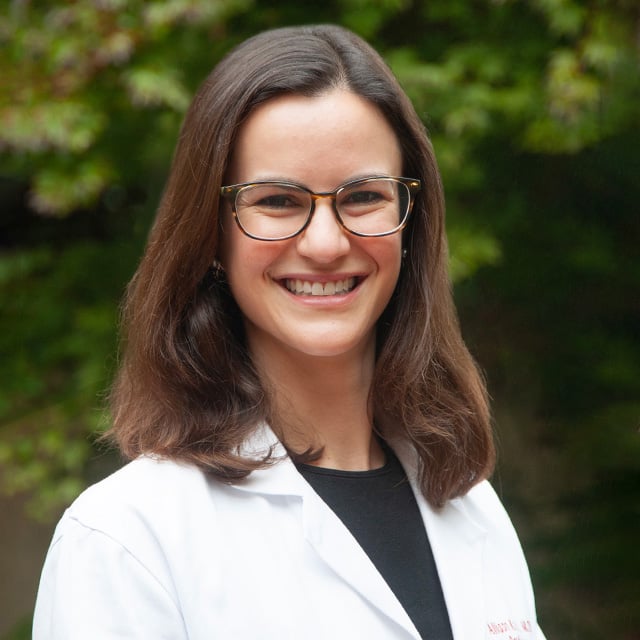
“I love people, and the human aspect of medicine drew me to this field,” said Allison Kratka, MD. “As a doctor, I get to meet people with interesting backgrounds that are different from mine, and I really enjoy talking with them. It’s a privilege to get to know people and to understand their own goals for care. As a doctor, I know what the guidelines say and what’s possible to offer, but I try to align that with what’s best for the patient in front of me, and to bring a patient-centered philosophy to the care I provide.”
Growing up in Eugene, Ore., where her mother was a gastroenterologist and her father was a nephrologist, she witnessed the connections they developed with their patients over 30 years. “Around town, patients would thank them for taking care of them,” said Dr. Kratka. “I could see that their relationships with patients were very meaningful.”
She earned her bachelor’s degree in psychology from Duke University, then spent a year as an AmeriCorps volunteer working with the Washington, D.C. Department of Public Health. Dr. Kratka helped implement HIV testing in public high schools and worked in an STD clinic for men. “It was a great year for getting a better sense of how to implement public health programs, and learning how they actually function,” she said.
She earned her medical degree at Duke University School of Medicine, and served as co-president for her medical school’s chapter of the Institute for Healthcare Improvement, which focuses on quality improvement (QI). “We set up a program pairing medical students and faculty members to work on QI projects, and organized a symposium at the end of the year for everyone to present their work,” said Dr. Kratka. “We also held events to help people learn more about QI, including hosting interesting speakers and conducting workshops on how to go through a fishbone diagram and other QI models.”
One of her own QI projects focused on trying to improve discharge appointment follow-up. “Sometimes things seem like they should be very simple, but this project helped me understand how coming up with a solution that functions for the people actually doing the work, then implementing it, is a whole different matter,” said Dr. Kratka.
She developed an interest in health policy, conducting research on health care price transparency. “At that time, people assumed that if we just made this information available to people, they would make smarter health care decisions that would bring down the price of health care,” said Dr. Kratka. “What we found was that the available information did not seem to be reliable or accurate, and wasn’t in a format that anyone could meaningfully use.”
She was also interested in patient decision-making, and helped lead projects exploring what risk of death people would be willing to take to find a cure for HIV as well as what factors contributed to patients’ decisions about whether or not to undergo prophylactic bilateral mastectomy to help prevent cancer.
Dr. Kratka completed her internal medicine residency at Brigham and Women’s Hospital in Boston, where cardiologist Kathryn Britton, MD, MPH, was one of her research mentors. Together they did QI work at the institution level and across disciplines, and also conducted research on heart failure readmission metrics.
“The uniting theme for all my research has been an interest in how we can improve how the health care system functions outside of direct clinical care, whether that’s through behavioral economics, quality improvement, or implementation science,” said Dr. Kratka.
Echocardiography and Valve Disease
Dr. Kratka’s interest in cardiology began in medical school. “I love physiology, and thought it was so cool to see how the heart functions, and how you can reason your way through most cardiac physiology problems,” she said. During medical school and residency, she appreciated the range of patients she got to care for in cardiology.
“I love taking care of sick patients on mechanical support in the CCU [Cardiac Care Unit], as well as older patients with atrial fibrillation who need an ablation,” said Dr. Kratka. “I also appreciated seeing patients who came in acutely ill due to a heart attack and got a stent, then seeing them in clinic six months later when they’re back to normal. I love the variety, and knowing that often we can get the answer and fix their problem. It’s also rewarding to care for patients with chronic issues we can’t fix yet, but we can care for them along the way. I love that cardiology encompasses all of this.”
After residency, she came to UCSF for her general cardiology and structural echocardiography fellowships. As a general cardiology fellow, she enjoyed all her rotations, and eventually found herself gravitating towards echocardiography. “Echo gives you that hemodynamic approach to the heart that I love so much in the CCU and cath lab, but non-invasively,” said Dr. Kratka. “Echo is the basis for starting to address almost every cardiac problem.”
In the second year of her fellowship, Ann Bolger, MD, a faculty member at Zuckerberg San Francisco General Hospital, encouraged Dr. Kratka’s interest in echocardiography. “She pulled back the veil on the underlying physics, demystified it, and taught me about how we can use Doppler to figure out hemodynamics, which was so fun,” said Dr. Kratka.
She also embraced the multidisciplinary approach to treating valve disease, in which surgeons, interventional cardiologists, general cardiologists, and non-invasive cardiologists collaborate in the care of complex patients. During her advanced fellowship in structural echocardiography, Dr. Kratka got to combine these two clinical interests.
She spent a year learning more about advanced cardiac imaging and gained expertise in transesophageal echocardiograms (TEEs), in which a probe is inserted into the mouth of a sedated patient and down into the esophagus, where it transmits high-resolution images of the heart. TEEs can be done diagnostically, and are also used to provide real-time imaging guidance to interventional cardiologists during structural procedures such as mitral valve edge-to-edge repairs (M-TEERs).“You get to help with a lot of the decision-making for these really complicated patients, which is intellectually engaging and very rewarding when you can help them feel better,” said Dr. Kratka.
A Wealth of Mentors
During her UCSF fellowships, she received guidance from many mentors. “Neal Shah was a great mentor in my structural echo fellowship, teaching me how to think about guiding the imaging during structural interventions,” said Dr. Kratka. “As both the fellowship program director and an echocardiographer, Atif Qasim is still the first person I turn to with a hard question. He really shaped my clinical reasoning, and has a very measured approach to clinical decision-making that takes patient preferences into account, as well as considering what we can do versus what’s reasonable.”
“Allison is an exceptional clinician whose diagnostic reasoning is thoughtful and precise, particularly in complex structural and echocardiographic cases,” said Dr. Qasim. “In clinic, she is warm, approachable, and consistently goes the extra mile to help patients understand their condition. She is especially thoughtful about shared decision-making, guiding patients through complex considerations around valve interventions with clarity and compassion.”
Dr. Kratka also appreciated the bedside manner of Donald Grandis, MD. “He remembers everyone’s grandkids, their cat’s name – all of it,” she said. “His patients have great respect for him and his opinions. Getting to see those long-term relationships and how people really valued his recommendations shaped my approach.”
She also worked closely with her research mentor, Sanket Dhruva, MD, MHS, a UCSF cardiologist based at the San Francisco Veterans Affairs Medical Center. Together they worked on several implementation science projects, including studying the efficacy of using informational letters or postcards to encourage patients with a pacemaker or implantable cardioverter-defibrillator (ICD) to send an electronic transmission report from their device; researching what patients and clinicians thought about relying on remote monitoring rather than in-person visits to check their ICDs; and investigating to what extent health insurance coverage of procedures used to diagnose and treat coronary artery disease aligned with clinical guidelines.
Dr. Kratka and Dr. Dhruva also led a heart failure remote monitoring implementation study. This pilot project investigated whether responding promptly to patients whose pacemaker or ICD sent an alert warning of a possible impending heart failure episode could actually avert a hospitalization.
“We took information from several VAs across the country and tried to act on it,” said Dr. Kratka. “We tested whether it would even be practical to respond to all the alerts. Who would respond – the nurse or the doctor? How would they do it? What medications would they give? If we could show safety and proof of concept, we could then do a larger randomized trial to see if this alert actually could help predict heart failure, and whether acting on that early prevented hospitalizations.”
Dr. Kratka led this pilot study, working with clinicians at all study sites and mentoring several residents. “It was a good lesson in change management, because we were asking people who had never met us to do more work by responding to new alerts,” she said. “They were all wonderful and wanted to do what’s right for patients.”
She appreciates everything she learned from Dr. Dhruva. “He has really shaped my critical thinking about trials, how I read the data, and how I approach problems,” said Dr. Kratka. “I always say he should write the book about how to be a great mentor, and everybody else should read it. He was so thoughtful about what projects I should spearhead and to gain relevant experience. He helped me decide what kind of career I wanted, identify what skills I’d need to do that, and how he could help me get those skills.”
“Dr. Kratka is a brilliant and creative cardiologist who is advancing patient care at the system level,” said Dr. Dhruva. “The work that she conducted during cardiology fellowship culminated in four lead author publications that included randomized trials, qualitative analyses, implementation, and health policy research. She is very well-positioned to contribute to advancing cardiovascular health through research endeavors.”
Clinical Excellence, Inclusive Community
After finishing her fellowship training, Dr. Kratka joined the UCSF Cardiology faculty in 2025. She has a busy clinical schedule, including spending time in the UCSF Echocardiography Lab, doing TEEs in the cath lab during structural procedures, and seeing general cardiology patients in the Daniel Burnham Court clinic. She also sees patients in a subspecialty non-invasive valve clinic. “If someone has complex valve disease and their cardiologist isn’t sure if they’re ready for an intervention or whether we should do further testing, we often see them in this clinic and do a complete evaluation before sending them to a surgeon, an interventional cardiologist, or both,” she said. She also participates in the interdisciplinary valve conference and collaborates in making tailored treatment recommendations for each patient.
She enjoys working with trainees. “When they ask me questions that I don’t know the answer to, I get to look it up and learn something myself,” said Dr. Kratka. “ I love getting to learn from them. That keeps everything fresh. It’s also wonderful to see trainees come into their own as they go from finding their footing at the beginning of the year, to gaining confidence and clinical expertise as time goes on.”
During her training, Dr. Kratka served as co-chief cardiology fellow and chief advanced echo fellow. She is a member of the American Society of Echocardiography and serves on the membership steering committee. She helped lead the fellows-in-training (FIT) training committee for the California Chapter of the American College of Cardiologists (ACC). She currently serves on the California Chapter of the ACC’s Women in Cardiology committee, participating in a mentorship day for high school, college, and medical students to encourage girls and young women to consider careers in medicine and cardiology.
“When I interviewed for fellowship at UCSF, I saw that there were so many female faculty members here – it was amazing,” said Dr. Kratka. “As a faculty member, I don’t really notice my gender at work. As a cardiologist, that’s quite a statement, given the percentages nationally. It’s not just women supporting women – I have a lot of male mentors who support me and other women. It’s nice to see a senior male faculty member who says, ‘I can’t stay late today, because I need to pick up my kids.’ There’s a mentality of excellence in clinical care here, but also a culture that your family is important. That’s wonderful, especially at this stage of life when many of us are parenting small children.”
She encourages trainees to enjoy the journey. “When I started medical school, I resolved to work really hard, but didn’t want to put my life on hold until I was an attending,” said Dr. Kratka. “My husband and I traveled together a lot when I was in medical school and residency. Although we only got two weeks of vacation, we were still able to do fun things together. I ran half marathons, had great friends, and occasionally did a 24-hour trip to a wedding. Life is long, and it doesn’t really get easier the further you go, when you have more things to balance. I encourage people to find someone whom you admire for both their clinical work as well as their overall life, and ask what they did to get there.”
Dr. Kratka is very glad to have joined the UCSF Cardiology faculty. “I love reading echoes in the lab, shoulder-to-shoulder with other doctors, talking and getting their advice about tough cases,” she said. “It’s very interesting and social, and you learn a lot that way…. UCSF is a place of clinical excellence. The people are very focused on providing the best care, and are also humble, friendly, and approachable.”
Outside of medicine, Dr. Kratka loves biking to work, skiing, hiking, and running. She and her husband, Michael, who works for McKinsey & Company, enjoy taking their young daughter, Anna, to the farmer’s market each week to buy fresh produce and flowers.
- Elizabeth Chur