
Faculty Spotlight: Prerna Gupta, MD
A Nudge in the Right Direction
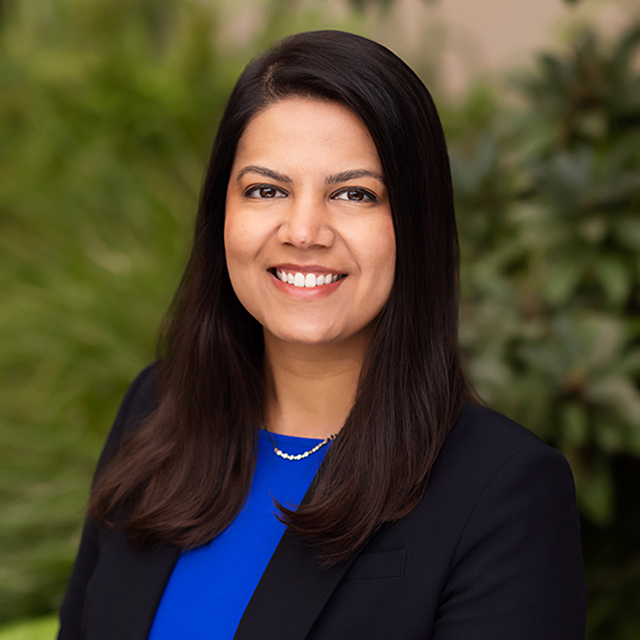
Photo credit: Andrea Rowe, UCSF
“There are lots of different things we can do in medicine, and outcomes research helps us understand where we can have the biggest impact on patients,” said cardiologist Prerna Gupta, MD, MS. “Within our resource constraints, how can we improve the care we deliver?”
Born in Delhi, she grew up in India and several California cities. Coming from a family with many doctors, she naturally gravitated towards a career in medicine. The summer before college, her physician mother helped arrange an opportunity to observe an open-heart surgery. “I saw the heart get drained of blood, and then I saw them return blood to the heart,” said Dr. Gupta. “That was incredible.”
She earned her bachelor’s degree in psychobiology from UCLA, where she also completed her medical degree and internal medicine residency. During training, she found cardiology especially appealing. “In cardiology, there are a lot of really amazing treatments to help people get better,” said Dr. Gupta. “It’s very gratifying to see someone who comes in with a heart attack improve dramatically with treatment. I also appreciate the variety of practice – you can have a very robust practice in clinic, and also take care of incredibly sick patients in the hospital. That diversity of experiences was very intellectually stimulating, and allowed me to see the full spectrum of cardiac illnesses.”
During medical school and residency, she conducted research with Biren Kamdar, MD, MBA, MS, MHS, a UC San Diego pulmonologist and critical care physician. His investigations focus on sleep, circadian rhythms, and improving hospital-induced delirium in the Intensive Care Unit (ICU). “He hypothesized that if we help patients get better sleep, maybe we can move the needle on ICU delirium, which makes patients very confused and agitated,” said Dr. Gupta.
As part of his lab’s investigations, Dr. Kamdar provided wearable devices called actigraphs to 34 ICU patients. A bit like Apple Watches, the wrist-worn devices measured activity of ICU patients. “He taught me how to code statistical software data, and encouraged me to explore that data and find interesting things,” said Dr. Gupta. They discovered that patients in the ICU were profoundly inactive. They also found that most ICU patients in the study exhibited circadian rest-activity misalignment, and had weak or absent light-dark exposure rhythms.
“It was interesting to see how data collected via this technological interface could be translated into something meaningful,” said Dr. Gupta. “It was also an early interaction with mobile health in medicine.” She learned a lot from doing a deep dive into the data, including poring through patients’ medical charts to glean information such as whether they were paralyzed or intubated. She found the experience helpful in learning how to do research while also juggling a heavy clinical load.
Leveraging Technology to Improve Heart Health
While completing her cardiology fellowship and earning her master’s degree in clinical sciences at the University of Colorado, Dr. Gupta worked with cardiologist Pamela Peterson, MD, MSPH, an expert in cardiovascular outcomes and cardiac rehabilitation. Cardiac rehabilitation is a medically supervised program designed to improve health after a heart attack, heart surgery, heart failure, or angioplasty. Participants meet in small groups, two to three times a week for 12 to 18 weeks. They receive exercise counseling and training, education about heart medications and healthy diet, and coaching on stress reduction.
Dr. Peterson led a clinical trial called the Enhancing Cardiac Rehabilitation Adherence through Home-Based Rehabilitation and Behavioral Nudges (ERA-Nudge) study, which offered patients a choice between hospital- or home-based cardiac rehabilitation programs. They tested whether letting patients pick an in-person or virtual cardiac rehab program might increase their likelihood of completing the program. The trial also compared the efficacy of sending tailored “nudge” messages versus generic reminders to encourage participants to practice health behavior.
“It was an incredibly interesting project,” said Dr. Gupta. “Instead of doing a deep dive into the data myself like I did with Dr. Kamdar, I got to be on trial teams to ask interesting questions, and worked with the statistician to discover the best way to ask those questions. Dr. Peterson has been not only a very important research mentor, but also an excellent sponsor throughout my fellowship and beyond.” The team is still analyzing its results from ERA-Nudge, and looks forward to publishing them.
Dr. Gupta also worked with Pei Jai Michael Ho, MD, PhD, a cardiologist at the University of Colorado and the Rocky Mountain Regional Veterans Affairs Medical Center. He led a study testing comparing the efficacy of letting patients opt out, instead of needing to opt in, to a low-risk intervention focused on medication adherence.
“There was a really interesting paper done a few decades ago that showed that the majority of heart failure patients don’t actually fit the enrollment criteria for major trials we use to treat patients,” said Dr. Gupta. “Trial patients are usually of higher socioeconomic status, less diverse, overwhelmingly male, and on the healthier side. Clinical trials don’t actually represent the people we treat.”
She hypothesizes that there may be some biases among physicians, who recommend trials to patients they think will attend follow-up appointments and complete the trial. “You want to avoid enrolling patients who will drop out, so that may automatically bias physicians towards people with resources,” said Dr. Gupta. Unfortunately, that often leads to trials not representing the very populations most affected by a health condition, such as heart disease.
Dr. Ho’s trial automatically enrolled patients with cardiovascular conditions such as hypertension, then tested various methods of nudging patients towards healthier behaviors via text messages or automated phone calls. Patients could bow out of the study any time, but 92 percent of the study population remained enrolled. “With automatic enrollment and the opt-out design, we found that Black, Latino, and Spanish-speaking patients opted out less often compared with patients who identified as white,” said Dr. Gupta. “That suggested it’s not that these populations are uninterested in participating in trials, but perhaps we are not accessing them for enrollment in the first place. That challenges some of the assumptions that clinicians might have in referring patients to trials, and suggests that we should probably bring trials to more people than we currently do.”
Expanding Access to Cardiac Rehabilitation
As Dr. Gupta was completing her fellowship, Dr. Peterson recommended she reach out to Carlin Long, MD, director of the UCSF Center for Prevention of Heart and Vascular Disease. Dr. Long previously served on the faculty of the University of Colorado as chief of cardiology at Denver Health Medical Center, the city’s safety net hospital. “When I was at the American Heart Association conference, he came by and we had a nice chat,” she said.
“I was first introduced to Dr Gupta by one of my prior mentees in Denver who described her as an ‘up-and-coming’ leader in the prevention space,” said Dr. Long. “We are thrilled her career path led her to the Prevention Center at UCSF. Her focus there, and here, is on helping to involve more people in cardiac rehabilitation, and engaging mobile technologies to help make this a reality.”
Later, when Dr. Gupta interviewed at UCSF for a faculty position, Jeffrey Olgin, MD, chief of the UCSF Division of Cardiology and Ernest Gallo-Kanu Chatterjee Distinguished Professor in Clinical Cardiology, encouraged her to connect with Alexis Beatty, MD, MAS, co-director of the UCSF Cardiac Rehabilitation and Wellness Center. “He told me that given my interest in cardiac rehab and mobile health, I should definitely meet with her,” said Dr. Gupta. “That ended up being a really great professional fit. Alexis has been an outstanding mentor, and took me on even before I started on faculty as I submitted a proposal for a K award.”
“Dr. Gupta's research on how we use technology to ‘nudge’ people to improve heart health will open new avenues for research and clinical care at UCSF,” said Dr. Beatty.
Now Dr. Gupta is collaborating with Dr. Beatty on the MCNAIR Study, which is comparing the effectiveness of in-person versus virtual cardiac rehabilitation programs. “It’s a bit different from the ERA-Nudge study, since it randomizes patients to either telehealth cardiac rehab or hospital-based rehab,” said Dr. Gupta. “I have an interesting background to bring to the study, and am excited to dive into the data.”
Whether cardiac rehabilitation programs are in-person or virtual, Dr. Gupta appreciates their importance. “If you’ve had heart surgery, people tell you to take it easy, but for how long?” she said. “In Denver, people would tell us that they were shoveling snow when they had their heart attack. Cardiac rehabilitation helps patients understand what’s okay for them to do, and how to increase activity slowly and safely. If patients go for a walk and it didn’t feel so good, they can talk with their exercise physiologist about it. Or if they take a walk and feel okay, they can get guidance about whether they can challenge themselves a bit more the next time.”
Dr. Gupta notes that while there is a high-risk subset of patients who do need monitoring as they recover from a major event like a heart attack, the overwhelming majority of patients can safely increase activity over time at home. “That’s the whole thesis behind virtual cardiac rehabilitation,” she said. “One of our patients in the ERA-Nudge study told us that they were never made to feel like they could increase their heart rate safely. It was important for them to go to cardiac rehabilitation to understand that exercise is safe and necessary to maintaining heart health.”
As a clinician, she has also seen how there is not a one-size-fits-all solution. “I had assumed that if home-based cardiac rehabilitation were available, that would improve outcomes, but some people really need the accountability of an appointment: ‘Today, I’m going to the hospital for cardiac rehabilitation, and that’s the only way I’ll get it done.’ That’s been surprising to me.”
Fostering a Spirit of Workplace Joy
In addition to her research, Dr. Gupta maintains a busy clinical schedule. She sees patients in clinic at the UCSF Berkeley Outpatient Center and the UCSF Center for Prevention of Heart and Vascular Disease at Mission Bay, and cares for inpatients at Moffitt Hospital. “I really enjoy building relationships with my patients and seeing them get better,” she said. “Patients can also be very interesting, clinically – I get to see the same disease present itself in 50 different ways, as well as rare diseases presenting themselves in unexpected ways. There’s much to be gained from being at a referral center like ours, where you’re taking care of illness that may be different from what you’d see elsewhere.”
Dr. Gupta also appreciates working with trainees. “I really enjoy working with fellows on the consult service, and it’s always nice to sit down and read through cases together,” she said. “On the resident service, we take a step back into cardiology fundamentals, and discuss things like how to read an EKG, or the jugular venous pressure. Cardiology and cardiac disease is such a big part of medicine, and it’s very gratifying to be part of an academic practice.”
She deeply values UCSF’s collaborative environment. “Whenever I turn to someone with a question about a case, they’re always very willing to listen and help,” said Dr. Gupta. “If I want to know more about something, I can find a world expert in that area on the faculty, email them, and learn from them. Every Thursday there’s a multidisciplinary conference where senior faculty and fellows log on, and you can bring interesting cases and discuss them together. Working in such a collegial atmosphere is good for both professional development and patient care, and fosters a spirit of workplace joy.”
Aside from medicine, Dr. Gupta enjoys watercolor painting and downhill skiing, a hobby she cultivated in the Colorado mountains during fellowship. She is married to Krish Bhutwala, a physicist at the Princeton Plasma Physics Laboratory. Together they have a young son, Ishaan.
- Elizabeth Chur