
Faculty Spotlight: Huie Lin, MD, PhD
Creating Better Systems of Care for ACHD Patients
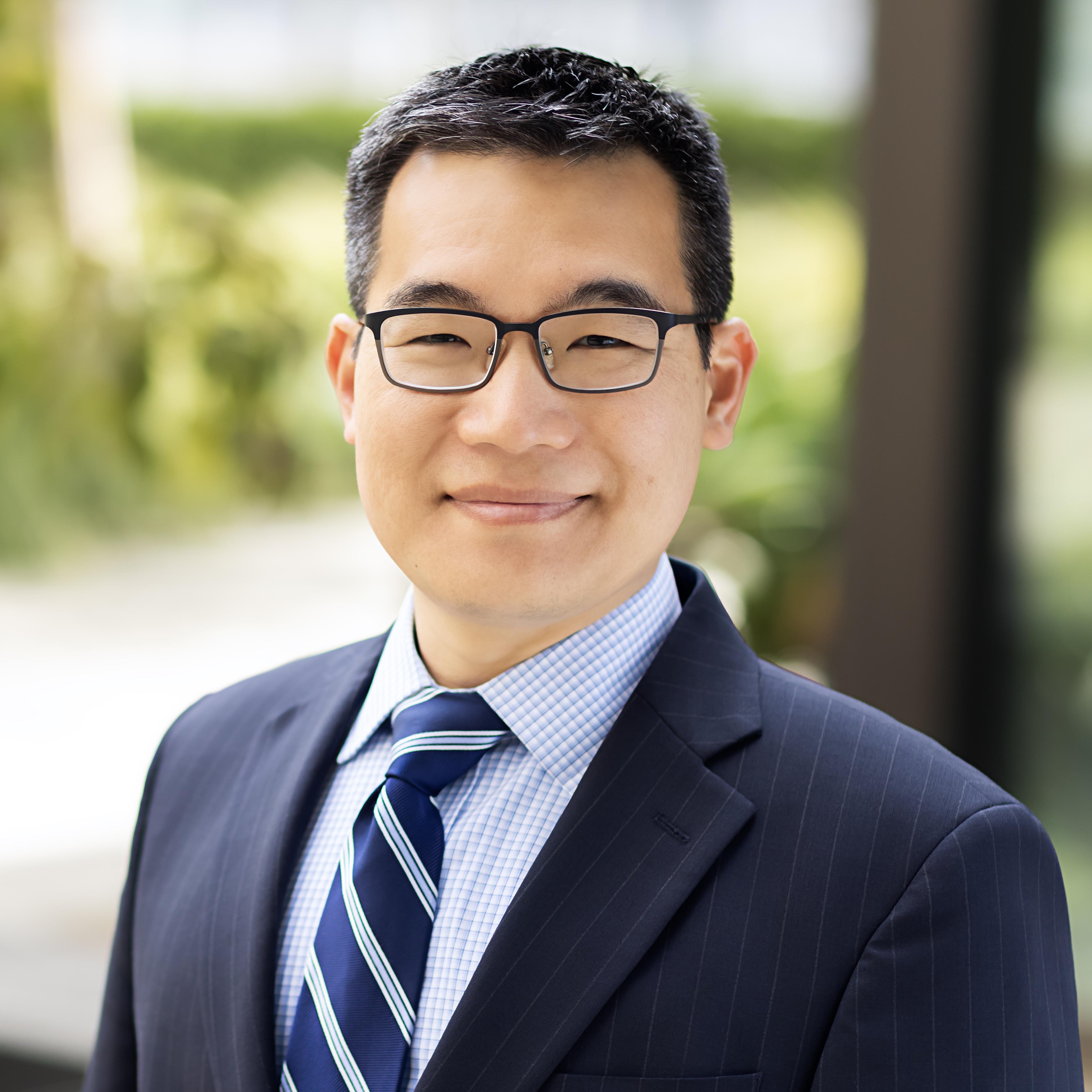
Photo credit: Andrea Rowe, UCSF
When Huie Lin, MD, PhD, was in college, his father had a heart attack. “That had a huge impact on my priorities, and I decided I wanted to become a cardiologist,” said Dr. Lin, now a UCSF Cardiology faculty member, director of Adult Congenital Interventional Cardiology, and William W. Parmley Endowed Chair in Cardiology.
Dr. Lin grew up in Tempe, Ariz. He earned his bachelor’s degree in psychobiology from Yale University and his medical degree and PhD in molecular physiology and biophysics from the University of Virginia in Charlottesville. For his PhD, he worked in the vascular biology lab of Gary Owens, PhD, studying mechanisms of vascular smooth muscle hypertrophy in the context of chronic high blood pressure.
He completed his internal medicine residency at Beth Israel Deaconess Medical Center in Boston, general cardiology and interventional cardiology fellowships at Barnes-Jewish Hospital at Washington University School of Medicine in St. Louis, Mo., and pediatric and congenital interventional cardiology fellowship at St. Louis Children’s Hospital, also at Washington University School of Medicine.
“My original goal was to become an interventional cardiologist to help patients like my dad,” said Dr. Lin. Then one of his mentors, John Lasala, MD, PhD, the interventional cardiology section chief at the time, asked Dr. Lin to do a case report. It focused on a patient who had a heart attack and a ventricular septal rupture, in which the wall between the lower right and left chambers of the heart ruptures and requires repair.
“Surgical mortality is extremely high, depending on how sick the patient is, and in certain situations the only option to fix it is using a transcatheter method,” said Dr. Lin. “Dr. Lasala told me the first thing I needed to do was talk with the pediatric interventional cardiologist, Dr. David Balzer, who said, ‘Why don’t you come to the cath lab and watch us do some cases?’ I’m so grateful to Dr. Lasala, because that opportunity was the turning point of my career.”
Many of Dr. Balzer’s patients had congenital heart disease (CHD), which are structural or functional problems of the heart that are present at birth. These problems affect nearly 1 percent of babies and include dozens of different conditions, ranging from mild to very serious. Even if these defects are treated in childhood, many patients require further treatment later in life.
“I was completely blown away when I got to the pediatric cath lab, because it was physiology in action,” recalled Dr. Lin. “What’s the physiology and anatomy? How do we fix it, and how does that change the physiology? It was remarkable, and that’s when I got bitten by the congenital heart disease bug.”
That experience also helped Dr. Lin realize the transformative potential of transcatheter interventions for CHD patients. “Some patients have already undergone two or three cardiac surgeries, and if they’re facing a fourth cardiac surgery, that’s a very high-risk procedure,” he said. Transcatheter interventions – delivering heart valves and other devices via a catheter inserted into a blood vessel up into the heart – provide a less invasive, lower-risk option.
Before the modern era of surgery, most children with complex heart defects died early. Thanks to major advances in recent decades, most babies with CHD now live into adulthood. Historically, most complicated CHD interventions have been done in pediatric cardiac catheterization labs. “For someone like me who wants to practice in adults, the only place they’re going to learn these interventions is in a pediatric hospital,” said Dr. Lin. “Dr. Balzer is brilliant. In addition to having phenomenal technical skills, his understanding of congenital physiology is on another level. He cuts through the complexities and gets to a solution. He had the foresight to recognize the importance of training people like me, who will take care of patients that he’s been caring for all his life who have become adults.”
During fellowship training, Dr. Lin also was inspired by another interventional cardiologist, Jasvindar Singh, MD. “As a former rugby player, he had a gruff manner,” said Dr. Lin. “But he was also a championship chess player and an incredible intellectual. With each case he thinks 20 steps ahead. Now when I plan my procedures, I aggressively plan for every possible problem, and how to work around them.”
Launching an ACHD Program
After completing his training, Dr. Lin became the founding director of the adult congenital heart program at Houston Methodist Hospital and the DeBakey Heart & Vascular Center. “When I arrived, Dr. Alan Lumsden, the chair of the Heart and Vascular Center, asked me to start this program,” said Dr. Lin. “It was challenging, since we didn’t have a pediatric [CHD] program that could serve as a built-in referral base. There is, however, a massive demand for adult congenital heart disease (ACHD) care. There are more than 2 million ACHD patients in the U.S., and that number continues to grow.”
Many ACHD patients fall out of care when they age out of pediatric cardiology programs. They may feel fine for a while, but some end up needing emergency care when long-term CHD complications arise. “We need adult cardiologists to understand how frequently they are seeing ACHD patients without initially recognizing their condition, and how these patients need to be managed differently than patients without ACHD,” said Dr. Lin.
Based on their experience, he and his colleagues published a paper on the critical elements needed to establish an ACHD program, including how to make a business case, build relationships across the hospital, and optimize a newly launched program. “Many people in this specialty are highly trained academics, but they also need to understand the business of medicine to build a successful ACHD program,” said Dr. Lin.
In collaboration with another mentor, Lisa Bergersen, MD, MPH, a pediatric interventional cardiologist at Boston Children’s Hospital, Dr. Lin worked on the Congenital Cardiac Catheterization Project on Outcomes (C3PO) study. This prospective registry included reporting data from all pediatric and congenital cardiac catheterizations at eight participating institutions. They identified factors associated with extremely high-risk patients, as well as the relationship of sedation and general anesthesia on congenital cardiac catheterization outcomes.
“While large-scale datasets can be challenging, because these are very complex procedures and sometimes the details can be lost, this was the first dataset that systematically enrolled every patient,” said Dr. Lin. “That doesn’t exist very often in CHD. Although I was not at Dr. Bergersen’s institution, she took me under her wing and gave me multiple projects to work on, which was transformational for my career.”
Prototyping with 3D Printing
In another research arena, Dr. Lin and his colleagues partnered with William Dore, Jr., a philanthropist in the energy industry who developed an enterprise 3D printing lab, an emerging technology at the time. “He was interested in designing rapid prototypes of pipeline fittings, which are not that different from heart and vascular [structures],” said Dr. Lin.
By gaining access to this technology, Dr. Lin and his partners used 3D printing to test innovative interventional solutions to complex ACHD cases. One of their patients had tetralogy of Fallot, a serious condition that includes four different heart abnormalities and usually requires a second surgical intervention in adulthood. However, as a Jehovah’s Witness, this patient was prohibited by her faith from receiving blood transfusions, which would increase the risk of open-heart surgery.
Dr. Lin and Mr. Dore’s team used 3D printing to create a model of her heart, using a material that mimicked the texture and mobility of a real heart. They tested the feasibility of implanting a transcatheter valve using a hybrid approach. Rather than stopping the heart, performing open-heart surgery, and using a heart-lung machine, which could have resulted in significant blood loss, they investigated whether they could partner with a surgeon to create a landing zone in which a transcatheter valve could be directly implanted through a small incision in the beating heart.
Using the 3D prototype, they estimated the patient would only lose a small amount of blood, and the patient agreed to move forward. The procedure went smoothly, and the patient successfully received the valve. “The whole experience was quite remarkable,” said Dr. Lin. “We had several other stories like this, and it was only possible through this collaboration with Mr. Dore and his 3D printing team.”
Depth Perception Improves Perspective
Dr. Lin is especially interested in bringing advanced cardiovascular imaging to the cardiac catheterization lab to support complex interventions in ACHD patients. Currently, interventional cardiologists use X-ray fluoroscopy to guide them; however, it produces somewhat fuzzy, 2D images, and also exposes patients to radiation.
One emerging technology is cardiac magnetic resonance imaging (MRI). It delivers clear, high-resolution images with 3D data, and enables quantitative measurement of blood flow and volume – all without radiation. “Cardiac MRI is extremely powerful, because it truly measures flow, rather than using a lot of mathematical assumptions,” said Dr. Lin. “If we could combine it with cardiac catheterization and intervention, including simultaneous direct measurement of pressures inside the heart, we could study physiology in a way that we have never been able to do before.”
Although cardiac MRI is becoming more common for diagnosis, it is not yet used to guide interventional cardiology procedures. One hurdle is that interventional tools need to be visible to an MRI scanner. Because current equipment was not designed for this, Dr. Lin and his colleagues developed a series of prototypes.
“We found that visualizing something on an MRI is probably easiest by creating an artifact, or ‘signal,’ via iron,” said Dr. Lin. “We painted iron oxide on the devices, but it was hard to get that coating to stick. Our collaborator had access to nanotechnology polymers, and they worked perfectly for our application. Our goal was to create a set of tools so that we could move on to exploring how cardiac catheterization and interventions could be revolutionized in an MRI environment.”
Other 3D cardiac imaging modalities, such as echocardiography and computed tomography (CT) scans, are closer to prime time – and Dr. Lin is helping to bring these powerful tools into the interventional space.
“It’s a shame, because while we now have diagnostic 3D datasets from MRI, CT, and echo, in the cardiac catheterization lab, we’re still working in a 2D environment and using flat X-ray imaging,” said Dr. Lin. “That means we have no depth perception, and we’re probably the last modality in medicine that remains that way. Our senior colleagues have 30 years or more of experience of using this 2D environment to figure things out in 3D in their head, and they are phenomenal at it. But those of us who are more junior haven’t mastered that learning curve yet, which makes complex procedures more difficult and time-consuming.”
Dr. Lin and his colleagues have worked to import and overlay 3D datasets onto the 2D environment of the cardiac cath lab. While it does not provide true depth perception, it can approximate location in 3D space. “That gives us a better sense of the best angle to approach things,” he said. They used this approach to incorporate 3D CT angiography in ACHD patients to better treat something called aortopulmonary collaterals. These precursor blood vessels connect the heart with the lungs during fetal life, but usually disappear once the normal heart grows. However, these protovessels persist in some ACHD patients. They look almost like rogue strands of spaghetti that randomly transport blood from the heart to the lungs, causing patients to cough up blood and sometimes leading to life-threatening complications.
One therapy to close these vessels uses a catheter to advance a very thin wire into these fragile, easily ruptured blood vessels. The interventional cardiologist delicately packs the wire into a tiny metallic ball and leaves it behind to permanently block the vessel, preventing abnormal blood flow. Dr. Lin and his team overlaid 3D CT imaging over 2D fluoroscopy to identify and treat as many of these problematic blood vessels as possible to prevent recurrent problems.
The emerging use of live 3D imaging technology has significant clinical benefits. “Having 3D echocardiography and true depth perception changes the game, adding another dimension of certainty for the operator and making the procedure faster, safer, and potentially enabling the development of novel transcatheter therapies,” said Dr. Lin. “We’re not fully there yet, but these technical advances are enabling a geometric progression of what we can do in the interventional space.”
Balloon Pulmonary Angioplasty
Dr. Lin also led creation of Houston Methodist Hospital’s Chronic Thromboembolic Pulmonary Hypertension (CTEPH) balloon pulmonary angioplasty program. Patients who develop persistent blood clots in the lung, also known as chronic pulmonary embolism, can develop elevated pressure in lungs or the right side of the heart, or CTEPH. “This can cause severe shortness of breath and limited physical abilities, and ultimately death,” said Dr. Lin.
Surgeons can remove large blood clots in the lung’s bigger blood vessels, but are unable to access clots in the very small vessels. In these cases, interventional cardiologists use balloon pulmonary angioplasty to treat pulmonary embolisms. Similar to an angioplasty in the heart, where they use an inflatable balloon to flatten plaques against the artery wall to open a blocked blood vessel, interventional cardiologists can deploy an inflatable balloon in the smaller branches of the pulmonary artery that are blocked by a blood clot.
“These clots are like a web, with strands that go across the lumen of the vessel,” said Dr. Lin. “What’s incredible is that you can use a balloon to break up those webs or push them out of the way – and then the body uses its own clot-dissolving mechanisms to start breaking down the rest of the blockage, once blood flow is partially restored.”
To build his skills in this area, Dr. Lin traveled to Japan to observe cases performed by Hiromi Matsubara, MD, PhD, the field’s foremost innovator. He also learned diagnostic pulmonary angiography from cardiologist Lori Daniels, MD, at UC San Diego, and received clinical guidance from Zachary Steinberg, MD, an interventional cardiologist at the University of Washington.
Empowerment through Education
In addition to leading clinical and research innovations, Dr. Lin is passionate about educating trainees and patients. He was inspired by Dr. Lumsden, a vascular surgeon who served as director of the DeBakey Heart & Vascular Center at Houston Methodist and is a champion of hands-on teaching. “He demonstrated how you could bring people in for a few days and teach them a remarkable amount,” said Dr. Lin.
With his partners, Dr. Lin established the Cardiology Fellows’ Bootcamp, a three-day intensive training that offers both lectures and hands-on practice in the Methodist Institute for Training, Innovation & Education, a state-of-the-art training and simulation center equipped with the latest tools and technologies.
“That was the inspiration for developing ‘Interventional Cardiology Finishing School,’” said Dr. Lin. “We realized there was a gap for interventional fellows who were about to graduate and start their first jobs. Some procedures they may have done only once or twice during fellowship, and would soon need to do these as an attending, without anyone to back them up.”
The finishing school brings together graduating interventional fellows from across the country for three days, pairing them up to practice high-risk, high-reward procedures in animal models. “They get to hone their skills in a safe environment that simulates real life so they will be prepared to do these procedures on their own in the real world,” said Dr. Lin.
For example, occasionally a transcatheter device slips out of place in the heart during a procedure, requiring an interventional cardiologist to snare and remove it from the body. “Fellows may have only done this procedure once during fellowship, but here they could practice over and over without worrying about potentially harming a patient,” said Dr. Lin. “Much of this was based on my own anxieties and experience gaps as a junior attending, and how to address those for future trainees.”
These successful training models also led to a similar patient education program – the Houston Methodist Adult Congenital Heart Symposium. ACHD patients and their family members have the opportunity to visit the same simulation lab to see and learn about heart valves, stents, angioplasty balloons, pacemakers, heart pumps, and other devices, and to deploy them in 3D printed models of the heart. “Putting their hands on these devices completely changed how they look at these procedures, which many of them have undergone or will in the future,” said Dr. Lin.
Because so many ACHD patients fall out of care or are reluctant to undergo more procedures, developing a deep understanding of their own anatomy and how interventions could benefit them is essential to informed decision-making. “This kind of training is an absolutely critical piece for helping ACHD patients bridge the knowledge gap between having a vague conception of procedures, to having a very concrete understanding and appreciating how fast this technology is developing,” said Dr. Lin.
The response has been overwhelmingly positive. “Mostly we see smiles and light bulbs, and hear them say, ‘Oh, that’s amazing!’” said Dr. Lin. “During one event, a patient’s mom and dad broke down crying and said, ‘You mean our daughter can get this [transcatheter valve] next time around, instead of having another open heart surgery?’ These patients have been through so much medical trauma. This education empowers them to become partners in their own care.”
To further augment patient-centered education, Dr. Lin and his team recruited patient and family stakeholders to serve as an advisory board for Adult Congenital Heart Symposium and subsequent online ACHD-focused education videos, and invited patients and their family members to serve as faculty and panelists. Some of the speakers were also health care providers themselves, bringing both their professional and personal experiences to the group.
Vision for the Future
While he greatly enjoyed his work at Houston Methodist Hospital, Dr. Lin was delighted to join the UCSF Cardiology faculty and the UCSF ACHD Program in 2025. “It’s always been a dream of mine to be at UCSF,” he said. “Back in Houston, I was at an adult-only hospital. But at UCSF, we have the opportunity to work with both UCSF Benioff Children’s Hospitals and the adult hospital, and to capture the entire spectrum. We’ll be able to reach pediatric patients, their parents, and adult patients.”
He appreciates his fruitful partnerships with both pediatric cardiologists and adult congenital cardiologists. “Before, I was more isolated because I didn’t have a pediatric environment to collaborate with, so it’s amazing to have that opportunity,” said Dr. Lin. “Phillip Moore, MD, MBA, chief of the Division of Pediatric Cardiology and co-director of the Pediatric Heart Center, has been a phenomenal mentor and an incredible support.”
“The UCSF Pediatric Heart Center is so excited to welcome Dr. Huie Lin to the UCSF ACHD team,” said Dr. Moore. “He brings an exceptional set of skills to advance our ability to treat adolescents and adults with complex congenital heart disease, including advanced pulmonary arterial disease, with innovative catheter techniques. His commitment to patient education and advocacy, excellent bedside manner, and focus on training the next generation of ACHD physicians will further advance the exceptional care UCSF provides to our ACHD patients!”
“We were fortunate to recruit Huie to UCSF to help build and grow two important programs for our patients,” said Jeffrey Olgin, MD, chief of the UCSF Division of Cardiology and Ernest Gallo-Kanu Chatterjee Distinguished Professor in Clinical Cardiology. “Those include an ACHD interventional program, where adult patients with congenital heart disease who most often survive to adulthood because of childhood surgery can undergo catheter-based procedures to address long-term consequences of their heart disease instead of going to surgery. He also leads a balloon pulmonary angioplasty program, whereby some of our very sick patients with pulmonary hypertension can have a procedure to open up blood vessels in the lungs to lower pressure in the lungs. Both programs are unique in Northern California, and Huie is building a world-class center here at UCSF which will be a destination for these very complex patients.”
Improving treatments are enabling many CHD patients to live well into adulthood and their senior years. Dr. Lin looks forward to building a world-class program to care for ever larger numbers of these patients. “We have a population of ACHD patients who have already had three or four heart surgeries,” he said. “Yes, we have phenomenal surgeons who can do a great job with fourth and fifth cardiac surgeries, but we really need to build our expertise and logistical capacity to take care of these adults in a transcatheter manner, so we can avoid additional surgeries whenever feasible.”
That includes not just technical expertise, but also training an expanded workforce with this specialized skill set, and building a more robust and sustainable ACHD care delivery system. “We have at least 2 million adults with ACHD who are going to need an enterprise solution – a systematic framework of care for transcatheter solutions, rather than acting like a startup where we reinvent the wheel for every patient,” said Dr. Lin. “I want to create standard operating procedures, built-in teams, workflows, logistics management, and patient education and advocacy, in order to do the right thing for these patients. My goal is to build these systems of care at UCSF, and teach the world how to do it.”
Outside of medicine, Dr. Lin loves to cook Texas-style barbecue and Chinese food, and watches YouTube videos to help him perfect his culinary technique. He is married to Serena Shen-Lin, ANP-BC, L.Ac., Dipl. OM, a nurse practitioner and acupuncturist.
- Elizabeth Chur